Manual handelling training
Manual handling
What is manual handling?
The workshops to do with the company Barbara Hilton - Hilfoot training taught us that manual handling is when lifting or putting down, pulling or pushing, carrying, supporting or moving an object, bending or twisting, person or animal using any part of your body. When the instructor spoke to us she told us the common cause of injuries in the workplace is poor posture, repetition of a task, heavy lifting, lack of time to recover, pulling or pushing objects, standing or sitting in a position without regular movement. People mistake injuries only come from lifting objects but it can come from any movement. I learnt from the source, to help prevent manual handling injuries in the workplace, you should avoid such tasks as far as possible. However, where it is not possible to avoid handling a load, employers must look at the risks of that task and put sensible health and safety measures in place to prevent and avoid injury. (Sourced from Hillfoot manual handling booklet https://www.qualsafe.com/products/Safe-Moving-and-Handling-Made-Easy-Book.html)
The cost of manual handling injuries
I learnt the cost of you get an injury you can have a serious effect on employers and employees. One of many that impacted by cost is Business. Business has to do legal advice and insurance cost, sick pay, lost production and sales, equipment and stock loss or damage, time and money spent on investigation and improvements and recruitment and payment of cover or replacement of staff. The human cost can be impacted by factors of pain and suffering, a disability that could lead to long-term, health care and rehabilitation, loss of earnings, emotional and financial burden on family and potential loss of life. Risk control is when you balance human and business costs for injuries. Employees And employers need to consider the hazards ( things that could cause harm to the person), the risk( the likelihood of the hazard happening) and the control measures( it's the action put into place to reduce the risk). (Sourced from Hillfoot manual handling booklet https://www.qualsafe.com/products/Safe-Moving-and-Handling-Made-Easy-Book.html)
The law for manual handling?
The booklet taught me about the acts to do with health and safety. The health and safety act of 1974 has a part to aim to encourage high standards and prevent people from harm in the working environment. The law relates to people in control of buildings have duties to people who aren't employed by them but at or visit the site. The equipment and articles must be designed, constructed and tested to ensure they will be safe and manufacture could be safe. As an employer, the act of "Duty care" is introducing a good health and safety practice and provides a framework for health and safety regulations. The employer is provided with written and safety policy, safe equipment and machinery, a safe system of work, safe working environment and information, instructions supervision and training. A self-employed person only gets the laws if they employ other people, their work presents a risk to their health and safety of others and they have to make sure their work doesn't endanger themselves or others and inform people of hazards. Employees all have a duty to act in a way that doesn't put others at risk or themselves and co-operate with other employers on any health and safety matters. The employer responsibility is to avoid the need for employees to perform any manual handling tasks at work which could result in an injury. But when it's not possible you must try to make a suitable assessment of the task to be undertaken, take steps to reduce the risk of injury, inform employees of the weight of the load and review produces if there has been a significant change to the manual handling operation or task. (Sourced from Hillfoot manual handling booklet https://www.qualsafe.com/products/Safe-Moving-and-Handling-Made-Easy-Book.html)
https://study.com/cimages/multimages/16/6c0628ba-8bee-4ae8-84ef-4a1fdee288d4_musculoskeletal.jpg

The musculoskeletal system
I learnt the musculoskeletal system is made up of the two systems that work together to allow you to support and move your body. The skeletal system is made up of bones of the skeleton, muscles, cartilage, tendons, ligaments, joints and other tissue that supports. The system provides form, support, stability and movement of the body. The spine has 4 main movements Flexion is the forward bending of the spine that occurs in the sagittal plane. The extension is the backward bending of the spine that occurs in the sagittal plane. Side Bending is the right or left bending of the spine that occurs in the frontal plane. Rotation is the turning of the spine to the right or to the left on the central axis of the body. There is more rotation in the cervical and thoracic spine than in the lumbar region. The process of safe manual handling protects your whole body but emphasises protection on the spine as it's the most common part of getting injured.
(Sourced from Hillfoot manual handling booklet https://www.qualsafe.com/products/Safe-Moving-and-Handling-Made-Easy-Book.html)
"From the research it taught me the spine has 3 main functions to protect the spinal cord, to allow movement and to support the upper body. In the spine, there are 33 bones and they are called vertebrae but these are held ligaments. Between each bone, there is a disc that acts as a shock absorber during such as running, jumping and walking. The outer part of the disc is made of lots of layers of cartilage and the inner nucleus. The disc enables the spine to flex and extend to allow smooth movement of the spine helping to bond the vertebrae together. One of the most common injury to the spine is slipped disc. This is where the layers of the cartilage (strong and flexible fibrous tissue, and it takes many forms and serves multiple purposes throughout the body) of the disc can become cracked and the inner nucleus pushes out of the crack. The shape of the vertebrae creates a canal to allow the spine to run down from the base of the brain. The nerves from the spinal cord branch out and leave space between the spine and the vertebrae. The spinal muscles, muscles and tendons provide spinal balance, stability and mobility. Muscles are attached to the vertebrae by the tendons. Muscles in the back are comparable to the muscles in the hand that control the fingers which tell us that it's a function will deal with the contractions such as lifting. Static work( doing intense work for a long period of time) also causes tiredness in the muscles quickly due to their size which results in long-term problems."(Sourced from Hillfoot manual handling booklet https://www.qualsafe.com/products/Safe-Moving-and-Handling-Made-Easy-Book.html)
(Image source:https://www.brighthubeducation.com/science-homework-help/107178-simple-machines-that-make-work-easier/)
 Mechanics of movement
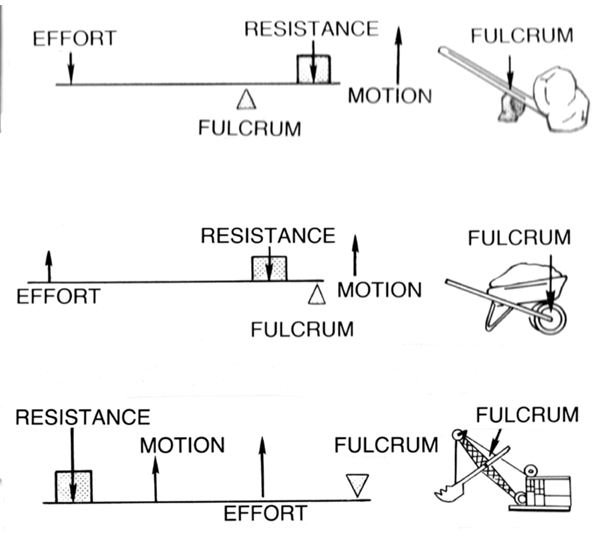
I learnt everyone and items have a centre of gravity and this is the point which the whole weight of an object can be considered to act making it balanced. When a person is standing still, their centre of gravity is located inside the body at the belly button. The position of the centre of gravity changes when you change your body position. The lever system is when the body uses levers to produce movement. A lever system is made up of three parts, an effort, a load and a fulcrum. In the human body, the effort is provided by the muscle (the muscles point of application/insertion), the load is the weight of the body and any additional resistance and the fulcrum is the joint itself. Lever systems have two main functions; firstly to increase the resistance that a given force can move and secondly to increase the speed at which a body moves. In addition, different lever systems allow different ranges of movement. This means that some lever systems are effective at overcoming a resistance, whilst others are able to generate speed. When lifting a load will require a force greater than which is needed to counterbalance it. When leaning you increase the amount of pressure on your back and adds additional pressure on the back muscles as the counterbalanced weight of both the object and your upper body.(Sourced from Hillfoot manual handling booklet https://www.qualsafe.com/products/Safe-Moving-and-Handling-Made-Easy-Book.html)
"In a first-class lever system, the fulcrum is the middle component and lies between the effort and load. One possible arrangement of muscles, bones, and joints found in the human body. The first class lever system, the fulcrum or pivot point is located on the lever between the effort force and load or resistance being moved. Your skull is the lever arm and the neck muscles at the back of the skull provide the force (effort) to lift your head up against the weight of the head (load). When the neck muscles relax, your head nods forward."(Sourced from Hillfoot manual handling booklet https://www.qualsafe.com/products/Safe-Moving-and-Handling-Made-Easy-Book.html)
"In a second class lever system, the load is the middle component and lies between the fulcrum and the effort. Exercises involving plantarflexion at the ankle (going up on your toes) are second-class lever systems, such as a calf raise or when jumping upwards whilst performing a layup in basketball. Second class lever systems only tend to increase the effect of the effort force, in other words, are effective at overcoming resistance as opposed to generating speed."(Sourced from Hillfoot manual handling booklethttps://www.qualsafe.com/products/Safe-Moving-and-Handling-Made-Easy-Book.html )
"The majority of movements in the human body are classified as third class lever systems. In a third class lever system, the effort is the middle component and lies between the fulcrum and load. There are many examples of third class lever systems, including both flexion and extension at the knee joint. These movements are involved in running, jumping and kicking. During flexion at the knee, the point of insertion of the hamstrings on the tibia is the effort, the knee joint is the fulcrum and the weight of the leg is the load. Third class lever systems are used to increase the speed of a body and allow a wide range of movement."(Sourced from Hillfoot manual handling booklet https://www.qualsafe.com/products/Safe-Moving-and-Handling-Made-Easy-Book.html)
(Image source:https://cdn.shopify.com/s/files/1/0011/7958/2517/articles/7-proper-lifting-techniques-for-heavy-objects_1400x.progressive.jpg?v=1525723871)
Body position
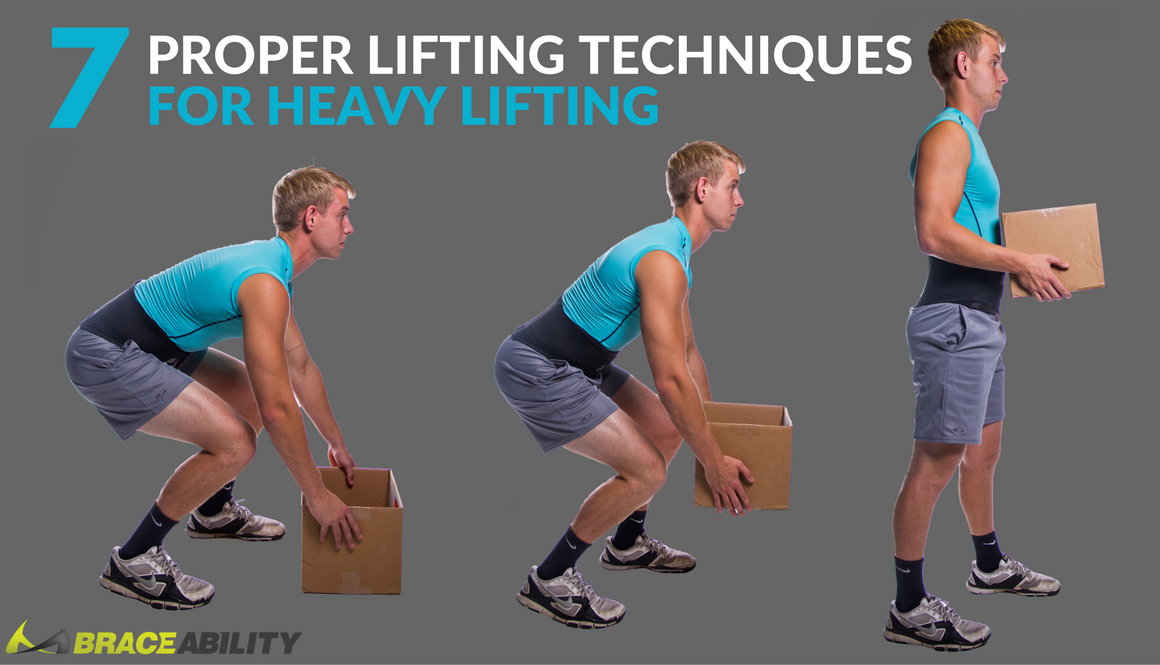
I learnt from the instructor when attempting to lift a load, make sure to consider whether the load is safe to lift. You can attempt to slide the object with your fingers. If the load is fragile and can be broken into small pieces ask for help. Also, if the load is sharp, hot or cold try and get protection for your hands such as gloves or an apron. The position of your body when performing manual handling tasks play an important role. It's important to have a stable base when moving objects when the centre of gravity at your feet. Your feet should be planted firmly on the floor shoulder width apart to better your balance keeping your knees bent. This will evenly distribute weight from the spine to the pelvis. The book taught me the decrease of pressure on your spine is when holding the load close to your body and the load being further away from the centre of gravity to greater the pressure on the spine. Gentle exercises such as stretches in the morning will warm up your muscles and joints to prepare for the actions of the day. Avoid twisting your body by aligning your feet, hips and shoulders. Bend at your hips and knees rather than your waist when performing activities such as picking up a toy, that requires bending and reaching towards the floor level. Squatting or sitting with your foot raised on a chair for nail care or to put shoes on reduces bending. Sitting allows a person to complete activities more safely, especially if the person has balance issues and is at risk of falling. Stand close to the object to avoid bending forward. When moving the object decrease the distance between you and the object as much as possible when reaching up with your arms. Avoid twisting and sudden movement and keep your eyes on where you are going.(Sourced from Hillfoot manual handling booklet https://www.qualsafe.com/products/Safe-Moving-and-Handling-Made-Easy-Book.html)
Types of injuries
Injuries can occur as the result of a single event or accident, poor posture, repetitive task and incorrect handling techniques. From the website http://www.hse.gov.uk/food/handling.htm "there are over 30% of food and drink industry injuries reported to HSE are manual handling injuries such as back injuries, this represents around 1700 acute injuries per year. Manual handling injuries are caused by handling and lifting -60% of the injuries involve lifting heavy objects."
"Abrasions, cuts and fractures are broken skin and broken bones can occur in various parts of the body. These are often caused by a single event or accident."(Sourced from Hillfoot manual handling booklet) "Abrasions can happen anywhere on the body. A person falling onto a rough surface, such as the sidewalk or a gravel-covered road, can cause them. To avoid further injury, abrasions should be cleaned very delicately with peroxide. A clean bandage should be applied afterwards."https://www.navicenthealth.org/service-center/urgent-care-navicent-health/sprains-strains-abrasions-cuts-burns-broken-bones "Minor cuts require only a gentle cleaning and an application of antibiotic cream. However, large cuts, or those that are deep, should be treated only by a physician. The injured person should have a clean bandage applied to the area. Pressure should be applied to try to stop the bleeding."https://www.navicenthealth.org/service-center/urgent-care-navicent-health/sprains-strains-abrasions-cuts-burns-broken-bones "A fracture is a break, usually in a bone. If the broken bone punctures the skin, it is called an open or compound fracture. Fractures commonly happen because of car accidents, falls, or sports injuries. Other causes are low bone density which causes weakening of the bones."https://www.navicenthealth.org/service-center/urgent-care-navicent-health/sprains-strains-abrasions-cuts-burns-broken-bones
(Image source:https://www.mayoclinic.org/diseases-conditions/rheumatoid-arthritis/symptoms-causes/syc-20353648)
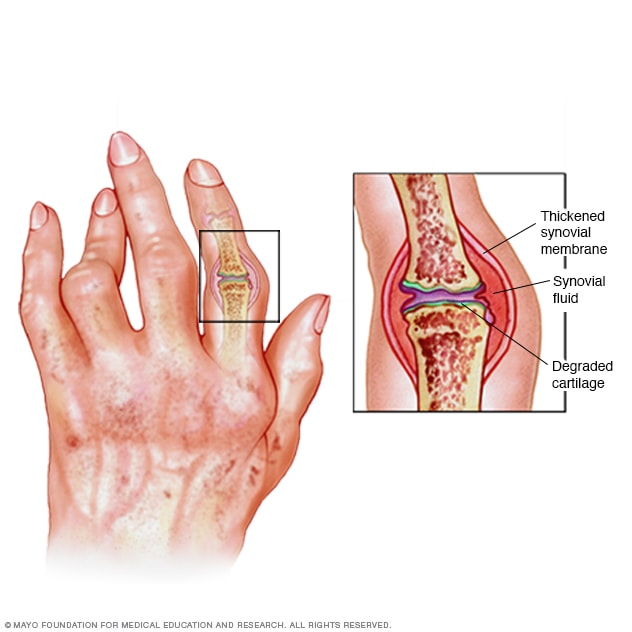
From this website I learnt, Arthritis is a term often used to mean any disorder that affects joints. Symptoms generally include joint pain and stiffness. Other symptoms may include redness, warmth, swelling, and decreased the range of motion of the affected joints. In some types, other organs are also affected. The inflammation of a joint is caused by the tear and wear of a repetitive task.https://en.wikipedia.org/wiki/Arthritis
This website taught me, back pain s a common reason for absence from work and for seeking medical treatment. It can be uncomfortable and pain in the lower back (lumbago) is particularly common, although it can be felt anywhere along the spine from the neck down to the hips. Back pain commonly stems from the strain, tension, or injury. Frequent causes of back pain are: strained muscles or ligaments a muscle spasm muscle tension damaged disks injuries, fractures, or falls." https://www.nhs.uk/conditions/back-pain/
"Carpal tunnel syndrome is a medical condition due to compression of the median nerve as it travels through the wrist at the carpal tunnel. The main symptoms are the pain, numbness and tingling in the thumb, index finger, middle finger and the thumb side of the ring fingers." https://en.wikipedia.org/wiki/Carpal_tunnel_syndrome
"A hernia occurs when an organ pushes through in the weakness of muscle or tissue that holds it in place. For example, the intestines may break through a weakened area in the abdominal wall. Hernias are most common in the abdomen, but they can also appear in the upper thigh, belly button, and groin areas". https://www.healthline.com/health/hernia
Muscle or ligament sprain or strain - "ligaments are bands of fibrous tissue that connect bones to bones at joints. Sprains usually happen when a person falls, twists, or is hit in a way that forces the body out of its normal position"https://www.health.harvard.edu/a_to_z/wrist-sprain-a-to-z .Also, it's a stretch or tears in a ligament. "A muscle strain, or pulled muscle, occurs when your muscle is overstretched or torn. This usually occurs as a result of fatigue, overuse, or improper use of a muscle." https://www.healthline.com/health/strains "It can happen in any muscle, but they’re most common in your lower back, neck, shoulder, and hamstring, which is the muscle behind your thigh. A strain is also a stretch or tear, but it happens in a muscle or a tendon."https://www.healthline.com/health/strains
I've learnt a slipped disc Injury or weakness can cause the inner portion of the disk to protrude through the outer ring. This is known as a slipped, herniated, or prolapsed disk. This causes pain and discomfort. If the slipped disk compresses one of your spinal nerves, you may also experience numbness and pain along the affected nerve." https://www.healthline.com/health/herniated-disk
"Tendonitis is when a tendon swells up and becomes painful after a tendon injury. You can treat mild tendon injuries yourself and should feel better within 2 to 3 weeks. Tendons are tough, flexible, fibrous bands of tissue that connect muscles to bones. When tendons become inflamed, irritated or suffer microscopic tears, the condition is called tendonitis".https://www.nhs.uk/conditions/tendonitis/ "In most cases, the cause of tendonitis is unknown for when a cause can be identified, the condition usually happens for one of two reasons overuse of particular body motion is repeated too often and an overload of the level of a certain activity, such as weightlifting, is increased too quickly."https://www.health.harvard.edu/diseases-and-conditions/tendonitis
Manual handling risk assessment
"Avoid - Can the task be avoided and could a piece of equipment perform the task instead of a person."(Sourced from Hillfoot manual handling booklethttps://www.qualsafe.com/products/Safe-Moving-and-Handling-Made-Easy-Book.html )
"Assess- They use T.I.L.E :
A task is when considering if the task involves twisting, reaching forward, carrying loads for long distances or carrying loads from the body. The individuals need personal protective equipment and have they received appropriate training. The load is considering the weight, size and stability of the load. The environment is an uneven floor, poor lighting and unhelpful temperatures. Also are there are seasonal factors to consider."(Sourced from Hillfoot manual handling booklet https://www.qualsafe.com/products/Safe-Moving-and-Handling-Made-Easy-Book.html)
"Reduce- Is considering the consequences of the injuries or harm, could someone is seriously injured or killed, can lots of people be affected, hazards should be addressed to authorities if it's an issue, could weight lifting equipment be decrease risk and a task be organised to reduce the risk of harm."(Sourced from Hillfoot manual handling booklet https://www.qualsafe.com/products/Safe-Moving-and-Handling-Made-Easy-Book.html)
"Review- Is it a legal requirement that businesses with 5 or more staff formally record their significant findings. It's important to implement the controls that have been identified to make sure that staff are trained in new procedures and to check that they are being followed correctly. Reviews should take place when procedures are revised, workplace layout is reorganised, new equipment is going to be used, an accident or near miss occurs, the law changes and the risk assessment changes."(Sourced from Hillfoot manual handling booklethttps://www.qualsafe.com/products/Safe-Moving-and-Handling-Made-Easy-Book.html)
What is manual handling?
The workshops to do with the company Barbara Hilton - Hilfoot training taught us that manual handling is when lifting or putting down, pulling or pushing, carrying, supporting or moving an object, bending or twisting, person or animal using any part of your body. When the instructor spoke to us she told us the common cause of injuries in the workplace is poor posture, repetition of a task, heavy lifting, lack of time to recover, pulling or pushing objects, standing or sitting in a position without regular movement. People mistake injuries only come from lifting objects but it can come from any movement. I learnt from the source, to help prevent manual handling injuries in the workplace, you should avoid such tasks as far as possible. However, where it is not possible to avoid handling a load, employers must look at the risks of that task and put sensible health and safety measures in place to prevent and avoid injury. (Sourced from Hillfoot manual handling booklet https://www.qualsafe.com/products/Safe-Moving-and-Handling-Made-Easy-Book.html)
The cost of manual handling injuries
I learnt the cost of you get an injury you can have a serious effect on employers and employees. One of many that impacted by cost is Business. Business has to do legal advice and insurance cost, sick pay, lost production and sales, equipment and stock loss or damage, time and money spent on investigation and improvements and recruitment and payment of cover or replacement of staff. The human cost can be impacted by factors of pain and suffering, a disability that could lead to long-term, health care and rehabilitation, loss of earnings, emotional and financial burden on family and potential loss of life. Risk control is when you balance human and business costs for injuries. Employees And employers need to consider the hazards ( things that could cause harm to the person), the risk( the likelihood of the hazard happening) and the control measures( it's the action put into place to reduce the risk). (Sourced from Hillfoot manual handling booklet https://www.qualsafe.com/products/Safe-Moving-and-Handling-Made-Easy-Book.html)
The law for manual handling?
The booklet taught me about the acts to do with health and safety. The health and safety act of 1974 has a part to aim to encourage high standards and prevent people from harm in the working environment. The law relates to people in control of buildings have duties to people who aren't employed by them but at or visit the site. The equipment and articles must be designed, constructed and tested to ensure they will be safe and manufacture could be safe. As an employer, the act of "Duty care" is introducing a good health and safety practice and provides a framework for health and safety regulations. The employer is provided with written and safety policy, safe equipment and machinery, a safe system of work, safe working environment and information, instructions supervision and training. A self-employed person only gets the laws if they employ other people, their work presents a risk to their health and safety of others and they have to make sure their work doesn't endanger themselves or others and inform people of hazards. Employees all have a duty to act in a way that doesn't put others at risk or themselves and co-operate with other employers on any health and safety matters. The employer responsibility is to avoid the need for employees to perform any manual handling tasks at work which could result in an injury. But when it's not possible you must try to make a suitable assessment of the task to be undertaken, take steps to reduce the risk of injury, inform employees of the weight of the load and review produces if there has been a significant change to the manual handling operation or task. (Sourced from Hillfoot manual handling booklet https://www.qualsafe.com/products/Safe-Moving-and-Handling-Made-Easy-Book.html)
https://study.com/cimages/multimages/16/6c0628ba-8bee-4ae8-84ef-4a1fdee288d4_musculoskeletal.jpg
The musculoskeletal system
I learnt the musculoskeletal system is made up of the two systems that work together to allow you to support and move your body. The skeletal system is made up of bones of the skeleton, muscles, cartilage, tendons, ligaments, joints and other tissue that supports. The system provides form, support, stability and movement of the body. The spine has 4 main movements Flexion is the forward bending of the spine that occurs in the sagittal plane. The extension is the backward bending of the spine that occurs in the sagittal plane. Side Bending is the right or left bending of the spine that occurs in the frontal plane. Rotation is the turning of the spine to the right or to the left on the central axis of the body. There is more rotation in the cervical and thoracic spine than in the lumbar region. The process of safe manual handling protects your whole body but emphasises protection on the spine as it's the most common part of getting injured.
(Sourced from Hillfoot manual handling booklet https://www.qualsafe.com/products/Safe-Moving-and-Handling-Made-Easy-Book.html)
"From the research it taught me the spine has 3 main functions to protect the spinal cord, to allow movement and to support the upper body. In the spine, there are 33 bones and they are called vertebrae but these are held ligaments. Between each bone, there is a disc that acts as a shock absorber during such as running, jumping and walking. The outer part of the disc is made of lots of layers of cartilage and the inner nucleus. The disc enables the spine to flex and extend to allow smooth movement of the spine helping to bond the vertebrae together. One of the most common injury to the spine is slipped disc. This is where the layers of the cartilage (strong and flexible fibrous tissue, and it takes many forms and serves multiple purposes throughout the body) of the disc can become cracked and the inner nucleus pushes out of the crack. The shape of the vertebrae creates a canal to allow the spine to run down from the base of the brain. The nerves from the spinal cord branch out and leave space between the spine and the vertebrae. The spinal muscles, muscles and tendons provide spinal balance, stability and mobility. Muscles are attached to the vertebrae by the tendons. Muscles in the back are comparable to the muscles in the hand that control the fingers which tell us that it's a function will deal with the contractions such as lifting. Static work( doing intense work for a long period of time) also causes tiredness in the muscles quickly due to their size which results in long-term problems."(Sourced from Hillfoot manual handling booklet https://www.qualsafe.com/products/Safe-Moving-and-Handling-Made-Easy-Book.html)
(Image source:https://www.brighthubeducation.com/science-homework-help/107178-simple-machines-that-make-work-easier/)
Mechanics of movement I learnt everyone and items have a centre of gravity and this is the point which the whole weight of an object can be considered to act making it balanced. When a person is standing still, their centre of gravity is located inside the body at the belly button. The position of the centre of gravity changes when you change your body position. The lever system is when the body uses levers to produce movement. A lever system is made up of three parts, an effort, a load and a fulcrum. In the human body, the effort is provided by the muscle (the muscles point of application/insertion), the load is the weight of the body and any additional resistance and the fulcrum is the joint itself. Lever systems have two main functions; firstly to increase the resistance that a given force can move and secondly to increase the speed at which a body moves. In addition, different lever systems allow different ranges of movement. This means that some lever systems are effective at overcoming a resistance, whilst others are able to generate speed. When lifting a load will require a force greater than which is needed to counterbalance it. When leaning you increase the amount of pressure on your back and adds additional pressure on the back muscles as the counterbalanced weight of both the object and your upper body.(Sourced from Hillfoot manual handling booklet https://www.qualsafe.com/products/Safe-Moving-and-Handling-Made-Easy-Book.html)
"In a first-class lever system, the fulcrum is the middle component and lies between the effort and load. One possible arrangement of muscles, bones, and joints found in the human body. The first class lever system, the fulcrum or pivot point is located on the lever between the effort force and load or resistance being moved. Your skull is the lever arm and the neck muscles at the back of the skull provide the force (effort) to lift your head up against the weight of the head (load). When the neck muscles relax, your head nods forward."(Sourced from Hillfoot manual handling booklet https://www.qualsafe.com/products/Safe-Moving-and-Handling-Made-Easy-Book.html)
"In a second class lever system, the load is the middle component and lies between the fulcrum and the effort. Exercises involving plantarflexion at the ankle (going up on your toes) are second-class lever systems, such as a calf raise or when jumping upwards whilst performing a layup in basketball. Second class lever systems only tend to increase the effect of the effort force, in other words, are effective at overcoming resistance as opposed to generating speed."(Sourced from Hillfoot manual handling booklethttps://www.qualsafe.com/products/Safe-Moving-and-Handling-Made-Easy-Book.html )
"The majority of movements in the human body are classified as third class lever systems. In a third class lever system, the effort is the middle component and lies between the fulcrum and load. There are many examples of third class lever systems, including both flexion and extension at the knee joint. These movements are involved in running, jumping and kicking. During flexion at the knee, the point of insertion of the hamstrings on the tibia is the effort, the knee joint is the fulcrum and the weight of the leg is the load. Third class lever systems are used to increase the speed of a body and allow a wide range of movement."(Sourced from Hillfoot manual handling booklet https://www.qualsafe.com/products/Safe-Moving-and-Handling-Made-Easy-Book.html)
(Image source:https://cdn.shopify.com/s/files/1/0011/7958/2517/articles/7-proper-lifting-techniques-for-heavy-objects_1400x.progressive.jpg?v=1525723871)
Body position
I learnt from the instructor when attempting to lift a load, make sure to consider whether the load is safe to lift. You can attempt to slide the object with your fingers. If the load is fragile and can be broken into small pieces ask for help. Also, if the load is sharp, hot or cold try and get protection for your hands such as gloves or an apron. The position of your body when performing manual handling tasks play an important role. It's important to have a stable base when moving objects when the centre of gravity at your feet. Your feet should be planted firmly on the floor shoulder width apart to better your balance keeping your knees bent. This will evenly distribute weight from the spine to the pelvis. The book taught me the decrease of pressure on your spine is when holding the load close to your body and the load being further away from the centre of gravity to greater the pressure on the spine. Gentle exercises such as stretches in the morning will warm up your muscles and joints to prepare for the actions of the day. Avoid twisting your body by aligning your feet, hips and shoulders. Bend at your hips and knees rather than your waist when performing activities such as picking up a toy, that requires bending and reaching towards the floor level. Squatting or sitting with your foot raised on a chair for nail care or to put shoes on reduces bending. Sitting allows a person to complete activities more safely, especially if the person has balance issues and is at risk of falling. Stand close to the object to avoid bending forward. When moving the object decrease the distance between you and the object as much as possible when reaching up with your arms. Avoid twisting and sudden movement and keep your eyes on where you are going.(Sourced from Hillfoot manual handling booklet https://www.qualsafe.com/products/Safe-Moving-and-Handling-Made-Easy-Book.html)
Types of injuries
Injuries can occur as the result of a single event or accident, poor posture, repetitive task and incorrect handling techniques. From the website http://www.hse.gov.uk/food/handling.htm "there are over 30% of food and drink industry injuries reported to HSE are manual handling injuries such as back injuries, this represents around 1700 acute injuries per year. Manual handling injuries are caused by handling and lifting -60% of the injuries involve lifting heavy objects."
"Abrasions, cuts and fractures are broken skin and broken bones can occur in various parts of the body. These are often caused by a single event or accident."(Sourced from Hillfoot manual handling booklet) "Abrasions can happen anywhere on the body. A person falling onto a rough surface, such as the sidewalk or a gravel-covered road, can cause them. To avoid further injury, abrasions should be cleaned very delicately with peroxide. A clean bandage should be applied afterwards."https://www.navicenthealth.org/service-center/urgent-care-navicent-health/sprains-strains-abrasions-cuts-burns-broken-bones "Minor cuts require only a gentle cleaning and an application of antibiotic cream. However, large cuts, or those that are deep, should be treated only by a physician. The injured person should have a clean bandage applied to the area. Pressure should be applied to try to stop the bleeding."https://www.navicenthealth.org/service-center/urgent-care-navicent-health/sprains-strains-abrasions-cuts-burns-broken-bones "A fracture is a break, usually in a bone. If the broken bone punctures the skin, it is called an open or compound fracture. Fractures commonly happen because of car accidents, falls, or sports injuries. Other causes are low bone density which causes weakening of the bones."https://www.navicenthealth.org/service-center/urgent-care-navicent-health/sprains-strains-abrasions-cuts-burns-broken-bones
(Image source:https://www.mayoclinic.org/diseases-conditions/rheumatoid-arthritis/symptoms-causes/syc-20353648)
From this website I learnt, Arthritis is a term often used to mean any disorder that affects joints. Symptoms generally include joint pain and stiffness. Other symptoms may include redness, warmth, swelling, and decreased the range of motion of the affected joints. In some types, other organs are also affected. The inflammation of a joint is caused by the tear and wear of a repetitive task.https://en.wikipedia.org/wiki/Arthritis
This website taught me, back pain s a common reason for absence from work and for seeking medical treatment. It can be uncomfortable and pain in the lower back (lumbago) is particularly common, although it can be felt anywhere along the spine from the neck down to the hips. Back pain commonly stems from the strain, tension, or injury. Frequent causes of back pain are: strained muscles or ligaments a muscle spasm muscle tension damaged disks injuries, fractures, or falls." https://www.nhs.uk/conditions/back-pain/
"Carpal tunnel syndrome is a medical condition due to compression of the median nerve as it travels through the wrist at the carpal tunnel. The main symptoms are the pain, numbness and tingling in the thumb, index finger, middle finger and the thumb side of the ring fingers." https://en.wikipedia.org/wiki/Carpal_tunnel_syndrome
"A hernia occurs when an organ pushes through in the weakness of muscle or tissue that holds it in place. For example, the intestines may break through a weakened area in the abdominal wall. Hernias are most common in the abdomen, but they can also appear in the upper thigh, belly button, and groin areas". https://www.healthline.com/health/hernia
Muscle or ligament sprain or strain - "ligaments are bands of fibrous tissue that connect bones to bones at joints. Sprains usually happen when a person falls, twists, or is hit in a way that forces the body out of its normal position"https://www.health.harvard.edu/a_to_z/wrist-sprain-a-to-z .Also, it's a stretch or tears in a ligament. "A muscle strain, or pulled muscle, occurs when your muscle is overstretched or torn. This usually occurs as a result of fatigue, overuse, or improper use of a muscle." https://www.healthline.com/health/strains "It can happen in any muscle, but they’re most common in your lower back, neck, shoulder, and hamstring, which is the muscle behind your thigh. A strain is also a stretch or tear, but it happens in a muscle or a tendon."https://www.healthline.com/health/strains
I've learnt a slipped disc Injury or weakness can cause the inner portion of the disk to protrude through the outer ring. This is known as a slipped, herniated, or prolapsed disk. This causes pain and discomfort. If the slipped disk compresses one of your spinal nerves, you may also experience numbness and pain along the affected nerve." https://www.healthline.com/health/herniated-disk
"Tendonitis is when a tendon swells up and becomes painful after a tendon injury. You can treat mild tendon injuries yourself and should feel better within 2 to 3 weeks. Tendons are tough, flexible, fibrous bands of tissue that connect muscles to bones. When tendons become inflamed, irritated or suffer microscopic tears, the condition is called tendonitis".https://www.nhs.uk/conditions/tendonitis/ "In most cases, the cause of tendonitis is unknown for when a cause can be identified, the condition usually happens for one of two reasons overuse of particular body motion is repeated too often and an overload of the level of a certain activity, such as weightlifting, is increased too quickly."https://www.health.harvard.edu/diseases-and-conditions/tendonitis
Manual handling risk assessment
"Avoid - Can the task be avoided and could a piece of equipment perform the task instead of a person."(Sourced from Hillfoot manual handling booklethttps://www.qualsafe.com/products/Safe-Moving-and-Handling-Made-Easy-Book.html )
"Assess- They use T.I.L.E :
A task is when considering if the task involves twisting, reaching forward, carrying loads for long distances or carrying loads from the body. The individuals need personal protective equipment and have they received appropriate training. The load is considering the weight, size and stability of the load. The environment is an uneven floor, poor lighting and unhelpful temperatures. Also are there are seasonal factors to consider."(Sourced from Hillfoot manual handling booklet https://www.qualsafe.com/products/Safe-Moving-and-Handling-Made-Easy-Book.html)
"Reduce- Is considering the consequences of the injuries or harm, could someone is seriously injured or killed, can lots of people be affected, hazards should be addressed to authorities if it's an issue, could weight lifting equipment be decrease risk and a task be organised to reduce the risk of harm."(Sourced from Hillfoot manual handling booklet https://www.qualsafe.com/products/Safe-Moving-and-Handling-Made-Easy-Book.html)
"Review- Is it a legal requirement that businesses with 5 or more staff formally record their significant findings. It's important to implement the controls that have been identified to make sure that staff are trained in new procedures and to check that they are being followed correctly. Reviews should take place when procedures are revised, workplace layout is reorganised, new equipment is going to be used, an accident or near miss occurs, the law changes and the risk assessment changes."(Sourced from Hillfoot manual handling booklethttps://www.qualsafe.com/products/Safe-Moving-and-Handling-Made-Easy-Book.html)


Comments
Post a Comment