Music studio introduction
Health and Safety
(source of Image: https://www.unilearning.co.uk/product/level-2-health-and-safety/ )
 Health and safety should be a musicians main priority when it comes to being in a room with lots of equipment. When you're in the rehearsal room(which is A5) or studio room (which is A7) there is a small sized stage based in front of you and there are hazards on the stage and surrounding the stage that could impact your health. This is important because health and safety policies in the workplace reduce the employee chances of injury. These policies can help you and your employees understand the potential hazards in your work environment. Training is important and effective, as it will educate your employees on proper workplace procedures, practices, and behaviour to prevent possible injuries and illness or contamination from improper hygiene. Paying for work-related injuries and illnesses can negatively affect your chance of long placement at work which is a big reason why the ideas of health and safety policies are necessary. Potential hazards are uncontrollable in almost every workplace environment. The equipment used, chemicals spread out, activities encountered and even furniture in the way can potentially cause injury or harm to you or your workers. Health hazards could cause contamination of the food due to unsafe handling or preparation practices to an infectious disease caused by improper hygiene and personal care. If you work with certain dangerous chemicals or gases, there's always the risk of improper handling, maintenance, or storage which could lead to dangerous exposure for you and your workers.
( source for the image: https://static1.squarespace.com/static/5533ab23e4b0cb1542aaea78/55341477e4b09e3f06190d60/5992f9a5f9a61e13c4556edb/1534127216324/band-set-up-1.jpg?format=1500w)
 The steps are the first main hazard because it causes you to be physically hurt. For example, the injuries could be banging your head against the floor causing you to have a small concussion which I would advise you not to start playing any instruments or start singing straight after because that would impact on your health. Another one could be twisting your ankle and drummers need their ankles to assist them when playing the kit on the drums. Also, you could sprain your wrist from when landing as your brain automatically sends signals to your hand for you to reach out to stop you from hitting the floor with lots of force.
(Source of image: https://www.sweetwater.com/insync/media/2013/06/cables_main-746x500.jpg )

The second health and safety issue is the cables, this isn't as obvious as other things because it normally runs along the walls of the stage or in parts of the stage. This is a problem because if you're not aware of the cables you could trip, buckle and fall to the ground causing you to have a long-term effect on your body. From my own experience, I realised old cables don't work efficiently as it used to work. This is because it's been worn out so it's important to replace old cable otherwise it could cause problems with things that it's connected to or it could cause problems to the input section of a mixer or speaker. This website taught me that to make using cables safer try to "relocate wires under or behind furniture or equipment so they are out of the way that way its prevention for a hazard. When cables are stretched across the floor, cover it, tape down or otherwise secure them to the floor. This will prevent people from getting their feet caught on the cable and tripping. Also, it's important to colour tape so it's visible for the person to see. Place devise and overhead or retractable cords on desktop surfaces instead of on the floor. Secure cords with zip ties to reduce slack and keep wires together. (source of paraphrase information: http://legacy.mohawkcollege.ca/Assets/Occupational+Health+and+Safety/Tripping+Hazard+Awareness.pdf ) .When entering the room if you have a drink in your hand your obviously not going to place a drink nearby any electric/expensive equipment because it could spill or leak onto the equipment causing it to stop working or have some long-term damage, that's why it's important to make sure if you do have a drink its not near any equipment.
(source of image: https://i0.wp.com/do-mindful.com/wp-content/uploads/2018/01/Obsessed-with-being-right-min.png?resize=300%2C300)

People need to be mindful of others or aware of their surroundings. This is important when rehearsing or being in studios because it's a compact environment so you want to be respected by the people around you so there's a good working atmosphere. Otherwise, there will be arguments and people won't produce good music because the dynamics aren't the best. Also, you don't want to be staring at a screen for a long period of time (this includes your phone, tv and computer) because it won't be good for your eyesight. This will make you tired and it's unhealthy to not have had enough sleep or to be staring at something with lots of light because when performing you don't want to be falling asleep that's why we need to have all the nutrients and energy you need. From the website, I learnt that being mindful improves your well-being which increases your capacity to support many attitudes that contribute to a satisfied life. Being mindful makes it easier to survive the pleasures in life and helps you become fully engaged in activities. Many people who practice mindfulness find that they are less likely to get caught up in worries about the future or regrets over the past. They are less occupied with concerns about success and self-esteem and are better able to form deep connections with others. Another aspect is it improves physical health. Discovered found that mindfulness techniques help improve physical health in a number of ways. Mindfulness can help relieve stress, treat heart disease, lower blood pressure and improve sleep difficulties. Mindfulness improves mental health. Meditation is an important element in the treatment of a number of problems including depression, substance abuse, eating disorders, anxiety disorders and obsessive-compulsive disorder. (Source of information: https://www.helpguide.org/harvard/benefits-of-mindfulness.htm )
 The website I researched from explained extreme levels of sound pressure can quickly cause hearing damage. A large number of performers decide to wear earplugs to protect their hearing but even the best earplugs cause some problems. Personal monitors offer a level of hearing protection but with the benefit of tiny loudspeakers in the plugs. The monitoring level is now in the hands of the performer, meaning if it seems to be too loud there is no excuse for not turning the monitors down to a comfortable level. Using a personal monitor is like using headphone but the sound goes where you go. Since professional earphones form a seal against background sound. Personal control is provided by systems that feature in a mix-mode. This is where it combines the left and right audio channels of a stereo system and sends the combined signal to both sides of the earphones. The balance control on the receiver acts as a mix control, allowing the performer to choose between two mixes or listen to a combination of both mixes with control over the level of each. By giving control of the monitor mix to the performer, the sound engineer can spend more time concentrating on making the band sound good for the audience instead of worrying about making the band happy. (Source of paraphrasing http://blog.shure.com/why-use-in-ear-monitor-systems/ )
(source of image: https://upload.wikimedia.org/wikipedia/commons/8/85/BedouinSoundclash.jpg)
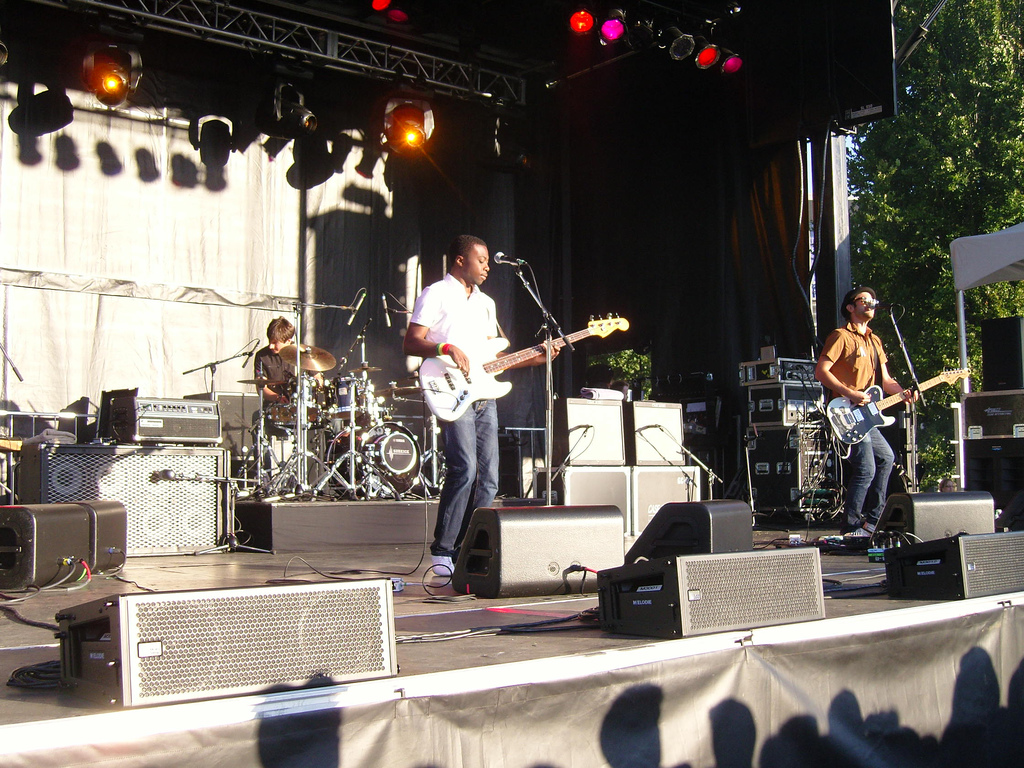
The backline - The backline is all the instruments and amps on the stage with their own monitors facing the musicians these include guitars, pianos, drum kit and other percussion instruments. When it comes to performance it's very important that the backline is in check because you don't want to limit a musicians potential when it comes to playing and the amps ensure the musician is in tune and that they can hear themselves clearly. Each artist, orchestra or band is different and will have different needs so the work can be varied. They will need to be comfortable with different types of equipment and different setups. The website explained depending on the musicians and the type of event the technician is working on they may be responsible for a range of road crew tasks or they may specialise in a particular area, such as percussion or strings. For a small scale performance, there may be one Backline Technician who is expected to deal with everything. ( source of paraphrase information: https://www.media-match.com/uk/music/jobtypes/backline-technician-jobs-402224.php ) I learnt from the website is, for a larger scale performance, there may be a number of Backline Technicians with different specialist responsibilities. Some sound technician specialising in drums will build the drum kit, soundcheck it with the sound team, make sure the drummer is happy with the setup and be responsible for looking after the kit while on tour. They will tune the drums and sometimes sit next to the drum riser for the performance, making any necessary adjustments. Others Technicians specialise in the sound itself or maybe more generalist and have a range of responsibilities. Backline Technician may need to help with unloading, then they will set up the equipment, including laptops and keyboards if necessary and be responsible for tuning and testing. (source of information:https://www.media-match.com/uk/music/jobtypes/backline-technician-jobs-402224.php)
( source of image: https://soundgirls.org/foh-engineer/ )
 The Front of house - The front of the house is the direction opposite from the stage, facing towards the audience. The speakers and monitors release sound and music facing the audience. That runs all the way to the back where the sound team is and there are speakers near where they are controlling. It's important that the front of house speakers and monitors are check properly because that's the sound that everyone backstage and the audio can hear and you would want them to enjoy the performance as much as they can. I've learnt from this website that, every instrument on stage has it’s own microphone and input from the lead singer all the way down to the individual drums and cymbals on the drum kit. The engineer controls the levels and equalization of the instruments and vocals blending them together, adding reverb and effects needed which is amplified through the PA system. The front of house engineer is only responsible for mixing one mix for all of the audience to listen to while a monitor engineer is responsible for many different mixes depending on what the performers need to hear. They listen to mixes through either speaker on the stage or in-ear monitors or a combination of both. Skills needed to be a sound engineer is an understanding of the concepts and terminology of audio and sound, signal flow and proper gain structure as well as the technical knowledge to operate mixing consoles and equipment. Even a well-trained ear and ability to recognize frequencies also good communication and people skills. Before the event takes place you might work with the director, sound designer and producer to plan the sound for an event. This is a detailed plan that ensures that everything happens at the right time during a performance, Ensure all the equipment is in good working order and attend rehearsals with the artists to plan the set-up and changes needed for the performance and prepare cue-sheets. On the day your work you would oversee the installation and set-up of the sound and mixing equipment, including the sound mixers and any playback equipment, Participate in sound checks with the artists before the performance, work as part of a wider team which includes lighting technicians and the director/producer. During the performance you would work from the mixing desk to control and balance sound levels, adding needed to microphone and instrument feeds such as equalisation, echo and other effects, Implement the changes to the mix as detailed in the Sound Plot throughout the show and work around any problems or issues that arise during the performance. (Source of information: https://soundgirls.org/foh-engineer/ )
Cables
(source of image: https://www.maniacfilms.com/images/xlr-cable2.jpg)
 XLR cables - This wire has a female and a male that is normally connected to a microphone. This connects the microphone to the mixer or the snake attached to the mixer. In some cases, you have the ability to connect wires like this to a piano either with a normal XLR, XLR with a jack cable or an XLR cable with an adapter that is in a form of a jack. The XLR is used across a broad range of musical and audio applications, due to the fact that it is both balanced and a very secure connection. As a general rule the female side plugs usually into the receive output signals from devices (a microphone, for example), and male XLR plugs are generally used to plug into inputs (a mic pre-amp on a mixing desk, or active studio monitors, for example), with male XLRs plugging into female sockets and vice versa. This cable is also used to connect speakers to a sound source. The wire comes in different lengths and it allows you to connect multiple wires together to reach speakers at specific parts of the venue. the wire can connect other speakers together but it's important that you chose a wire in good condition otherwise the wires won't work on the speaker or it will cause lots of feedback. Keeping the wire organised is important as it gets tangled up with other wires and it takes a very long time to detangle. The wire sometimes starts to curl up into different shapes and this is because it has been wrapped up in a certain way constantly or it doesn't get wrapped properly causing the wire to not work as well as it used to work. This wire can connect amps to a keyboard when there aren't any other jacks available.
The female connection
https://www.dawsons.co.uk/blog/wp-content/uploads/2011/09/xlr-fem-plug.jpg
https://www.dawsons.co.uk/blog/wp-content/uploads/2011/09/xlr-fem-plug.jpg


The male connection:

 https://www.dawsons.co.uk/blog/wp-content/uploads/2011/09/xlr-male-plug.jpg
https://www.dawsons.co.uk/blog/wp-content/uploads/2011/09/xlr-fem-socket.jpg
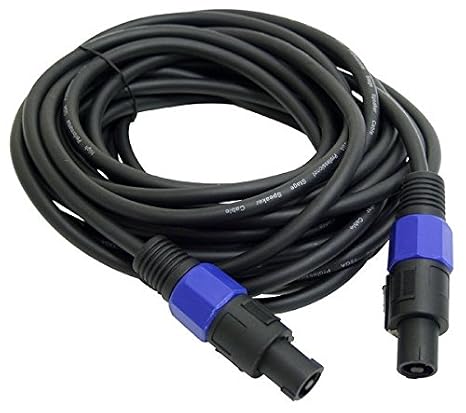
Speak-on cable/ NL8 - This is normally connected to passive speakers because they don't have a power cable input and when connected it's automatically on. This is useful for the speaker because the speaker won't need much caballing reducing someone from getting injured and prevents the wires from getting tangled up. The Speakon is designed to take high current signals. Typically, female plugs connect to male panel sockets and have a twist-lock mechanism that secures them into the socket. This makes Speak-on connectors ideal for live sound applications, most commonly connecting power amplifiers to loudspeakers. As a result, Speak-on to XLR cables is also very common.
(source for image: https://media.rs-online.com/t_large/F7440941-01.jpg)
 ICE cable/ Power cable/ kettle plug - This is used to give power to speakers, mixers and amps connected to a switch against the wall or a power lead. This is also used to give power to amps used for instruments such as bass, guitar and keyboard. This cable is very important because of its giving power to the amp it allows to strengthen the weak electric signals of the instrument and it gives it power directly from the source. The ICE cable is also used for lighting equipment and it helps the lights be placed at different parts of the venue.
(source of Image: https://www.unilearning.co.uk/product/level-2-health-and-safety/ )
( source for the image: https://static1.squarespace.com/static/5533ab23e4b0cb1542aaea78/55341477e4b09e3f06190d60/5992f9a5f9a61e13c4556edb/1534127216324/band-set-up-1.jpg?format=1500w)
The steps are the first main hazard because it causes you to be physically hurt. For example, the injuries could be banging your head against the floor causing you to have a small concussion which I would advise you not to start playing any instruments or start singing straight after because that would impact on your health. Another one could be twisting your ankle and drummers need their ankles to assist them when playing the kit on the drums. Also, you could sprain your wrist from when landing as your brain automatically sends signals to your hand for you to reach out to stop you from hitting the floor with lots of force.(Source of image: https://www.sweetwater.com/insync/media/2013/06/cables_main-746x500.jpg )
The second health and safety issue is the cables, this isn't as obvious as other things because it normally runs along the walls of the stage or in parts of the stage. This is a problem because if you're not aware of the cables you could trip, buckle and fall to the ground causing you to have a long-term effect on your body. From my own experience, I realised old cables don't work efficiently as it used to work. This is because it's been worn out so it's important to replace old cable otherwise it could cause problems with things that it's connected to or it could cause problems to the input section of a mixer or speaker. This website taught me that to make using cables safer try to "relocate wires under or behind furniture or equipment so they are out of the way that way its prevention for a hazard. When cables are stretched across the floor, cover it, tape down or otherwise secure them to the floor. This will prevent people from getting their feet caught on the cable and tripping. Also, it's important to colour tape so it's visible for the person to see. Place devise and overhead or retractable cords on desktop surfaces instead of on the floor. Secure cords with zip ties to reduce slack and keep wires together. (source of paraphrase information: http://legacy.mohawkcollege.ca/Assets/Occupational+Health+and+Safety/Tripping+Hazard+Awareness.pdf ) .When entering the room if you have a drink in your hand your obviously not going to place a drink nearby any electric/expensive equipment because it could spill or leak onto the equipment causing it to stop working or have some long-term damage, that's why it's important to make sure if you do have a drink its not near any equipment.
(source of image: https://i0.wp.com/do-mindful.com/wp-content/uploads/2018/01/Obsessed-with-being-right-min.png?resize=300%2C300)
People need to be mindful of others or aware of their surroundings. This is important when rehearsing or being in studios because it's a compact environment so you want to be respected by the people around you so there's a good working atmosphere. Otherwise, there will be arguments and people won't produce good music because the dynamics aren't the best. Also, you don't want to be staring at a screen for a long period of time (this includes your phone, tv and computer) because it won't be good for your eyesight. This will make you tired and it's unhealthy to not have had enough sleep or to be staring at something with lots of light because when performing you don't want to be falling asleep that's why we need to have all the nutrients and energy you need. From the website, I learnt that being mindful improves your well-being which increases your capacity to support many attitudes that contribute to a satisfied life. Being mindful makes it easier to survive the pleasures in life and helps you become fully engaged in activities. Many people who practice mindfulness find that they are less likely to get caught up in worries about the future or regrets over the past. They are less occupied with concerns about success and self-esteem and are better able to form deep connections with others. Another aspect is it improves physical health. Discovered found that mindfulness techniques help improve physical health in a number of ways. Mindfulness can help relieve stress, treat heart disease, lower blood pressure and improve sleep difficulties. Mindfulness improves mental health. Meditation is an important element in the treatment of a number of problems including depression, substance abuse, eating disorders, anxiety disorders and obsessive-compulsive disorder. (Source of information: https://www.helpguide.org/harvard/benefits-of-mindfulness.htm )
The speakers are very loud so you don't want to stand nearby the speakers for a long period of time otherwise you could get permanent hearing loss or tinnitus (this is when your ear tissue bursts and you get constant ringing in your ears when listening to music). That's why construction workers wear ear protectors to protect their ears from the loud drilling or the loud banging of equipment. Also, being nearby loud music for long periods of time cause temporary hearing loss meaning you won't be able to hear properly for a while.(Source of image: https://www.djtimes.com/ear-monitors-superb-studio-apps/)
The website I researched from explained extreme levels of sound pressure can quickly cause hearing damage. A large number of performers decide to wear earplugs to protect their hearing but even the best earplugs cause some problems. Personal monitors offer a level of hearing protection but with the benefit of tiny loudspeakers in the plugs. The monitoring level is now in the hands of the performer, meaning if it seems to be too loud there is no excuse for not turning the monitors down to a comfortable level. Using a personal monitor is like using headphone but the sound goes where you go. Since professional earphones form a seal against background sound. Personal control is provided by systems that feature in a mix-mode. This is where it combines the left and right audio channels of a stereo system and sends the combined signal to both sides of the earphones. The balance control on the receiver acts as a mix control, allowing the performer to choose between two mixes or listen to a combination of both mixes with control over the level of each. By giving control of the monitor mix to the performer, the sound engineer can spend more time concentrating on making the band sound good for the audience instead of worrying about making the band happy. (Source of paraphrasing http://blog.shure.com/why-use-in-ear-monitor-systems/ )
Music terminology
(source of image: https://upload.wikimedia.org/wikipedia/commons/8/85/BedouinSoundclash.jpg)
The backline - The backline is all the instruments and amps on the stage with their own monitors facing the musicians these include guitars, pianos, drum kit and other percussion instruments. When it comes to performance it's very important that the backline is in check because you don't want to limit a musicians potential when it comes to playing and the amps ensure the musician is in tune and that they can hear themselves clearly. Each artist, orchestra or band is different and will have different needs so the work can be varied. They will need to be comfortable with different types of equipment and different setups. The website explained depending on the musicians and the type of event the technician is working on they may be responsible for a range of road crew tasks or they may specialise in a particular area, such as percussion or strings. For a small scale performance, there may be one Backline Technician who is expected to deal with everything. ( source of paraphrase information: https://www.media-match.com/uk/music/jobtypes/backline-technician-jobs-402224.php ) I learnt from the website is, for a larger scale performance, there may be a number of Backline Technicians with different specialist responsibilities. Some sound technician specialising in drums will build the drum kit, soundcheck it with the sound team, make sure the drummer is happy with the setup and be responsible for looking after the kit while on tour. They will tune the drums and sometimes sit next to the drum riser for the performance, making any necessary adjustments. Others Technicians specialise in the sound itself or maybe more generalist and have a range of responsibilities. Backline Technician may need to help with unloading, then they will set up the equipment, including laptops and keyboards if necessary and be responsible for tuning and testing. (source of information:https://www.media-match.com/uk/music/jobtypes/backline-technician-jobs-402224.php)
( source of image: https://soundgirls.org/foh-engineer/ )
The Front of house - The front of the house is the direction opposite from the stage, facing towards the audience. The speakers and monitors release sound and music facing the audience. That runs all the way to the back where the sound team is and there are speakers near where they are controlling. It's important that the front of house speakers and monitors are check properly because that's the sound that everyone backstage and the audio can hear and you would want them to enjoy the performance as much as they can. I've learnt from this website that, every instrument on stage has it’s own microphone and input from the lead singer all the way down to the individual drums and cymbals on the drum kit. The engineer controls the levels and equalization of the instruments and vocals blending them together, adding reverb and effects needed which is amplified through the PA system. The front of house engineer is only responsible for mixing one mix for all of the audience to listen to while a monitor engineer is responsible for many different mixes depending on what the performers need to hear. They listen to mixes through either speaker on the stage or in-ear monitors or a combination of both. Skills needed to be a sound engineer is an understanding of the concepts and terminology of audio and sound, signal flow and proper gain structure as well as the technical knowledge to operate mixing consoles and equipment. Even a well-trained ear and ability to recognize frequencies also good communication and people skills. Before the event takes place you might work with the director, sound designer and producer to plan the sound for an event. This is a detailed plan that ensures that everything happens at the right time during a performance, Ensure all the equipment is in good working order and attend rehearsals with the artists to plan the set-up and changes needed for the performance and prepare cue-sheets. On the day your work you would oversee the installation and set-up of the sound and mixing equipment, including the sound mixers and any playback equipment, Participate in sound checks with the artists before the performance, work as part of a wider team which includes lighting technicians and the director/producer. During the performance you would work from the mixing desk to control and balance sound levels, adding needed to microphone and instrument feeds such as equalisation, echo and other effects, Implement the changes to the mix as detailed in the Sound Plot throughout the show and work around any problems or issues that arise during the performance. (Source of information: https://soundgirls.org/foh-engineer/ )(source of image: https://www.maniacfilms.com/images/xlr-cable2.jpg)
XLR cables - This wire has a female and a male that is normally connected to a microphone. This connects the microphone to the mixer or the snake attached to the mixer. In some cases, you have the ability to connect wires like this to a piano either with a normal XLR, XLR with a jack cable or an XLR cable with an adapter that is in a form of a jack. The XLR is used across a broad range of musical and audio applications, due to the fact that it is both balanced and a very secure connection. As a general rule the female side plugs usually into the receive output signals from devices (a microphone, for example), and male XLR plugs are generally used to plug into inputs (a mic pre-amp on a mixing desk, or active studio monitors, for example), with male XLRs plugging into female sockets and vice versa. This cable is also used to connect speakers to a sound source. The wire comes in different lengths and it allows you to connect multiple wires together to reach speakers at specific parts of the venue. the wire can connect other speakers together but it's important that you chose a wire in good condition otherwise the wires won't work on the speaker or it will cause lots of feedback. Keeping the wire organised is important as it gets tangled up with other wires and it takes a very long time to detangle. The wire sometimes starts to curl up into different shapes and this is because it has been wrapped up in a certain way constantly or it doesn't get wrapped properly causing the wire to not work as well as it used to work. This wire can connect amps to a keyboard when there aren't any other jacks available. The female connection
https://www.dawsons.co.uk/blog/wp-content/uploads/2011/09/xlr-fem-plug.jpg
https://www.dawsons.co.uk/blog/wp-content/uploads/2011/09/xlr-fem-plug.jpg
The male connection:
https://www.dawsons.co.uk/blog/wp-content/uploads/2011/09/xlr-male-plug.jpghttps://www.dawsons.co.uk/blog/wp-content/uploads/2011/09/xlr-fem-socket.jpg
Speak-on cable/ NL8 - This is normally connected to passive speakers because they don't have a power cable input and when connected it's automatically on. This is useful for the speaker because the speaker won't need much caballing reducing someone from getting injured and prevents the wires from getting tangled up. The Speakon is designed to take high current signals. Typically, female plugs connect to male panel sockets and have a twist-lock mechanism that secures them into the socket. This makes Speak-on connectors ideal for live sound applications, most commonly connecting power amplifiers to loudspeakers. As a result, Speak-on to XLR cables is also very common.
(source for image: https://media.rs-online.com/t_large/F7440941-01.jpg)
ICE cable/ Power cable/ kettle plug - This is used to give power to speakers, mixers and amps connected to a switch against the wall or a power lead. This is also used to give power to amps used for instruments such as bass, guitar and keyboard. This cable is very important because of its giving power to the amp it allows to strengthen the weak electric signals of the instrument and it gives it power directly from the source. The ICE cable is also used for lighting equipment and it helps the lights be placed at different parts of the venue.
Jack cables
(Source of image: https://www.tonedeafltd.co.uk/media/catalog/product/n/y/nyg-ic008-3842.jpg)
 This is what a guitarist or pianist used to connect the instrument to their amps.
You're able to get jacks in all different length,
the different material surrounding the wire and(Source of image: https://www.tonedeafltd.co.uk/media/catalog/product/n/y/nyg-ic008-3842.jpg)
This is what a guitarist or pianist used to connect the instrument to their amps.You're able to get jacks in all different length,
even different colours. From the website, I learnt the stereo jack is the most common connection to be found on musical equipment. The mono jack is connected to electric guitars and guitar amps. The balance jack connection carries two channels of audio (a stereo signal, with separate left and right channel). The tip, ring, sleeve (TRS) design, the plug itself now divided with two black hoops. The stereo minijack is the plug that's usually found on MP3 player headphones, TRS arrangement is used for the left or right channels. The unbalanced and mono cables are usually found on DJ mixers and audio interfaces. This connects to the mixing desks and usually features a red, right channel connection and a white, left channel connection. (source for information: https://www.dawsons.co.uk/blog/a-guide-to-types-of-cable-connector)
(Source of image:https://www.dawsons.co.uk/blog/wp-content/uploads/2011/09/stereo-jack.jpg)

(Source of the image: https://www.dawsons.co.uk/blog/wp-content/uploads/2011/09/rca.jpg)

. (Source of image: https://www.dawsons.co.uk/blog/wp-content/uploads/2011/09/mini-jack-crop.jpg)

(Source of image:https://www.dawsons.co.uk/blog/wp-content/uploads/2011/09/stereo-jack.jpg)
(Source of the image: https://www.dawsons.co.uk/blog/wp-content/uploads/2011/09/rca.jpg)
. (Source of image: https://www.dawsons.co.uk/blog/wp-content/uploads/2011/09/mini-jack-crop.jpg)


Comments
Post a Comment