Music equipment
Music equipment
Speakers
Microphones
https://www.bhphotovideo.com/images/images2500x2500/Shure_SM58S_SM58S_Cardioid_Dynamic_68464.jpg
Dynamic microphone
 Microphone/ SM58 - This Is also know as a dynamic microphone and it's what singers use to speak through or sing through that is connect an XLR cable that connects to the mix. The mic sometimes will be attached to a mic holder that is connected to a mic stand. I've learnt, the case of a dynamic microphone, a very thin diaphragm of Mylar or other material is attached to a coil of hair-thin copper wire. The coil is suspended in a magnetic field and, when sound vibrates the diaphragm, the coil moves up and down, creating a very small electrical current. The electrical signal is attached to a connector on the microphone. Just plug it in and it works. Source for information: https://quizlet.com/247356975/audio-production-quiz-2-flash-cards/)
Polar patterns
https://blog.discmakers.com/2015/03/pros-and-cons-of-the-figure-8-mic/
 Polar pattern refers to a microphone's directionality or pickup pattern the three- space surrounding the capsule where it is most sensitive to sound.
"An omnidirectional polar pattern picks up sound in a 360-degree radius – it is equally sensitive to sound at all angles. Imagine its pattern as a perfect sphere in three directions. This makes omnidirectional microphones ideal for studio recordings where the objective is a natural, open sound. These microphones are especially well-suited for recording acoustic instruments and when recording a wide sound source, such as an orchestra or choir. They’re also good for lavalier mics, such as the LC82 MD of the MicroLite series, since the user can move his or her head without the volume varying. Of course, all this means that omnidirectional mics are not generally recommended for live performances, where they’re likely to pick up unwanted sounds such as amplified instruments or a PA system and thus cause feedback. They’re also not recommended when recording in an untreated room with poor acoustics. In those situations close miking is advised, and that’s where a cardioid mic comes in. We’ll explore the pros and cons of cardioid mics in our next polar pattern instalment. "http://www.akglife.com/polar-patterns--part-1-omnidirectional--technology
"Cardioid is the most widely used pattern in professional microphones. It provides reliable performance in both stage and studio settings—making it an excellent “jack of all trades” polar pattern. Cardioid mics have a heart-shaped pickup pattern and are most sensitive in the front of the mic. As you move around to the sides and bottom of the microphone, the cardioid pattern becomes less sensitive and will pick up less sound. A good way to visualize this is to think of the cardioid pattern as an apple, with the microphone as the stem. The closer you are to the ‘stem’, the less sensitive the mic is. "http://www.akglife.com/polar-patterns--part-2-cardioid--technology
"The figure of eight is similar to cardioid mics where it picks up sound in front, become less sensitive around the sides and completely reject sound at the rear. They use an even tighter pickup area at the head of the mic, quickly taper to reject sound from the sides and have a very small lobe of sensitivity near the rear of the mic. You could say it’s the stricter, more “focused” brother of the cardioid pattern. "http://www.akglife.com/polar-patterns--part-4-figure-8--technology
Condenser Microphone
https://www.neumann.com/homestudio/en/what-is-a-condenser-microphone

I've learnt that the condenser microphone is similar to a dynamic microphone as they are both used to enhance the sound through it more. It consists of a thin membrane in close to a solid metal plate that must be electrically conductive. When sound waves hit the diaphragm and the distance between the two plates changes. this results in the changes to the rhythm of the sound waves.The condenser capsule’s output voltage is actually quite high but it produces almost no current because so little energy is stored in this small capacitor. https://www.thoughtco.com/condenser-vs-dynamic-microphones-1817725
I've learnt large-diaphragm microphones (LDMs) are most often the choice for studio vocals and any instrument recording where a deeper sound is desired. A large-diaphragm microphone warms up the sound of what it's recording, which also leads to the myth that most LDMs reproduce low frequencies better than small diaphragm mics.https://www.thoughtco.com/condenser-vs-dynamic-microphones-1817725
I've learnt that small-diaphragm microphones (SDMs) are the best choice when you want a solid, wide-frequency response and the best transient response, which as noted above, is the ability for your microphone to reproduce fast sounds, such as stringed instruments. SDMs are also the preferred choice for concert taping. The microphone delivers incredible sound quality for lead vocals and solo instruments and has nine selectable polar patterns, plus three attenuation levels for close-up recording or high-output sources. And three switchable bass-cut filters help to reduce wind noise and stage vibration.https://www.thoughtco.com/condenser-vs-dynamic-microphones-1817725
Mixing desk
 A mixer will have a number of input channels with its own audio signal combined with other signals from other channels. This is normally based at the back of the mixer or at the front on top with two types of inputs/ inserts a three pin XLR socket which is commonly connected to microphones and the 1/4 jack that's connected to guitars, pianos or devices such as CD players, iPods or laptops. There will at least be some 1/4 jacks or phono sockets at the master section for connecting stereo signals.
The mixer combines all signals from all channels then goes out the mixer through the output section. All mixers have a main out a 1/4 jack inserts for left and right and a headphone or phones output. There will be a knob or fader controlling the overall of the mix (master fader) and there will be a knob or fader controlling the phones output independently. Also, there will be a mono 1/4 that for the aux if when playing music out loud or wanting to connect a device to the mixer. Smaller mixers have a tape in or tape out a duo of phono sockets.

 (image source:https://www.dawsons.co.uk/blog/wp-content/uploads/2013/03/EQ.jpg)
(image source: https://www.dawsons.co.uk/blog/wp-content/uploads/2013/03/auxilliary.jpg)
 Amplifier(AUX) - The AUX knob controls the levels of Auxilliary, sent off to the AUX output. This allows the user to create mixes to adjust the levels of the channel signal. The purpose of this is to send signals to the monitors on the stage to help them hear what they are playing clearly. This also sends the audio into an effective unit where you can use reverb or delay allowing engineers to adjust the levels of effect for each individual channel.
(image source:https://www.dawsons.co.uk/blog/wp-content/uploads/2013/03/Pan.jpg)
 Pan - Panorama is the knob that controls which area of the field the signal is put out to when turning it either to left, right or centre for the speakers. This is useful because it reduces the amount of sound coming out from a speaker prevent the speaker from popping and the person sitting in front won't getting strain in their eardrums.
(image source:https://www.dawsons.co.uk/blog/wp-content/uploads/2013/03/mute.jpg)
 Mute - The mute button allows engineers to individually mute a channel which stops the sound from coming out of the output. The pro for this is your ability to mute if someones going off or if you're trying to change the caballing and you don't
want there to be bad feedback, so muting the mic will prevent this from happening.
This is a video of me connecting an analogue mixer to a passive speaker
Speakers
There are two types of speakers a passive and active they both serve the same purpose which is to produce sound but each is used in a different way from another.
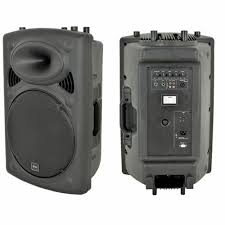
Active speaker
(source for image: https://encrypted-tbn0.gstatic.com/images?q=tbn:ANd9GcRc7ghPjTleUao9xN3LDfSVSI2-Rs7ZUYSqJ4jNXKjAsmRX8CAx)
The active speaker already has a built-in amplifier so it doesn't need to have trails of racks of amplifier called a power amplifier. For the speaker to have the power it needs to have a power cable/IEC attached to it. When using this it needs to be connected to an XLR cable in order for there to be sound coming out from it. The pros are you're able to control the sound levels directly on and from the mixer but also on the separately upgrade the power amplifier from the back of the speaker. The speaker takes less time to set up, it can be plugged in anywhere that has socket holes. The amplifier is already tuned inside the speaker. You're able to directly go right up to the speaker and adjust and there is no need to have any experience. Also, the speaker gives you the ability to connect to other speakers. The cons are if a part of the speaker is broken the whole speaker will be taken it repairs just for the one part and sometimes you would need to update the amplifier.
Passive speaker
(source for image: https://www.gearank.com/sites/default/files/Behringer-Eurolive-B212XL.jpg)
 The passive speaker doesn't have a built-in amplifier so it does need an amplifier rack that gives it an amplifier called a power amplifier. This will need lots of power from a power amplifier to power it properly and when building a chain of speakers there will be a lot of loss cables. The resistance will build up and there will be less output for each speaker. You will only need a speak-on cable and it saves you time from finding a spot to plug in a power cable. The pros are you're able to the separately upgrade the power amplifier from the speaker. The speakers are lightweight because it doesn't have an amplifier built into it, this means it's easier to lift and install. Also, there will be an ability to change the speaker at any time anywhere around the venue. The cons of the speaker are you have to find the right amplifier that suits the speaker otherwise it won't give you sound the way you want it. Also when connecting the speakers to different parts of the venue, there will be signal loss.
Power amplifier (source for image:https://cosmomusic.ca/media/catalog/product/cache/1/image/9df78eab33525d08d6e5fb8d27136e95/P/S/PSAPYAMPX3_1_7.jpg
https://www.electronicshub.org/power-amplifier/ )
 The power amplifier is a source that provides the amplifier's power to one or more speakers. This sends and increases the signals that are adjusted to the volume and tone sent from the mixer. It takes power from the supply connected to the output circuit and converts its useful signal. The power is developed at the output of the power amplifier that is controlled by the input signal. The performance of the power amplifier is depending on collector efficiency, power dissipation capability and distortion. "The distortion is the change of output waveform from the input waveform of the amplifier known as distortion. The collector efficiency is the ratio of AC output power to the DC input power or zero signal power of the power amplifier. The main use of this is to tell the percentage of the DC power converted into AC power by the amplifier."https://www.electronics-tutorials.ws/amplifier/amp_5.html "The power dissipation capability is the ability of transistor to dissipate heat developed in this. Power transistors used in a power amplifier carries large current during operation which heats up the collector junction. The rise in temperature influences the operating conditions of the transistor".https://analyseameter.com/2016/04/power-amplifier-definition-properties-and-classifications.html
(source for image: https://www.alibaba.com/product-detail/Top-Sale-Pa-System-Power-Line_60448964769.html)
The line array speakers

From this website, I learnt the line array speakers are speakers joined together in a curve shape. The purpose of this was instead of the sound travelling forward it can travel in all directions so it can fill up the whole room. A cylindrical waveform will create a wavefront of sound pressure that is loosely cylindrical in nature at a particular range of wavelengths (frequencies). The interference pattern is when you stack a bunch of loudspeakers, the vertical dispersion angle decreases because the arrivals from individual drivers are out of phase with each other at positions off-axis in the vertical plane. The taller the stack is, the narrower the vertical dispersion will be and the higher the sensitivity will be on-axis. In the horizontal plane, an array of like drivers will have the same polar pattern as a single driver. https://www.astralsound.com/line-array.htm
Subwoofer speaker
https://en.audiofanzine.com/hk-audio/series-actor-dx/medias/other/
 "A subwoofer is a type of speaker that reproduces only the lowest of audible frequencies. In home theatre, this is often referred to as LFE (Low-Frequency Effects). Home theatre surround sound is implemented by 5 or more channels, with each channel represented by a speaker. With home theatre sound systems requiring specialized speakers for centre channel dialogue, main soundtracks, surround, and sometimes even height effects, the need for a speaker to reproduce just the deep bass portion of a movie soundtrack is all the more important. Although a home subwoofer is not quite as "thunderous" like the ones at the local movie theatre, it can still shake the house down or annoy the downstairs neighbours in your apartment or condo complex. The subwoofer should not sound "boomy", but deep and tight. This is especially important if you intend to use your subwoofer for music listening. Many subwoofers are great for Blu-ray Disc or DVD movies, but may not perform well with the subtle deep bass in music performances."https://www.howtogeek.com/354985/what-are-woofers-mid-range-speakers-and-tweeters/
Active speaker
(source for image: https://encrypted-tbn0.gstatic.com/images?q=tbn:ANd9GcRc7ghPjTleUao9xN3LDfSVSI2-Rs7ZUYSqJ4jNXKjAsmRX8CAx)
The active speaker already has a built-in amplifier so it doesn't need to have trails of racks of amplifier called a power amplifier. For the speaker to have the power it needs to have a power cable/IEC attached to it. When using this it needs to be connected to an XLR cable in order for there to be sound coming out from it. The pros are you're able to control the sound levels directly on and from the mixer but also on the separately upgrade the power amplifier from the back of the speaker. The speaker takes less time to set up, it can be plugged in anywhere that has socket holes. The amplifier is already tuned inside the speaker. You're able to directly go right up to the speaker and adjust and there is no need to have any experience. Also, the speaker gives you the ability to connect to other speakers. The cons are if a part of the speaker is broken the whole speaker will be taken it repairs just for the one part and sometimes you would need to update the amplifier.
Passive speaker
(source for image: https://www.gearank.com/sites/default/files/Behringer-Eurolive-B212XL.jpg)
Power amplifier (source for image:https://cosmomusic.ca/media/catalog/product/cache/1/image/9df78eab33525d08d6e5fb8d27136e95/P/S/PSAPYAMPX3_1_7.jpg
https://www.electronicshub.org/power-amplifier/ )
(source for image: https://www.alibaba.com/product-detail/Top-Sale-Pa-System-Power-Line_60448964769.html)
The line array speakers
From this website, I learnt the line array speakers are speakers joined together in a curve shape. The purpose of this was instead of the sound travelling forward it can travel in all directions so it can fill up the whole room. A cylindrical waveform will create a wavefront of sound pressure that is loosely cylindrical in nature at a particular range of wavelengths (frequencies). The interference pattern is when you stack a bunch of loudspeakers, the vertical dispersion angle decreases because the arrivals from individual drivers are out of phase with each other at positions off-axis in the vertical plane. The taller the stack is, the narrower the vertical dispersion will be and the higher the sensitivity will be on-axis. In the horizontal plane, an array of like drivers will have the same polar pattern as a single driver. https://www.astralsound.com/line-array.htm
Subwoofer speaker
https://en.audiofanzine.com/hk-audio/series-actor-dx/medias/other/
"A subwoofer is a type of speaker that reproduces only the lowest of audible frequencies. In home theatre, this is often referred to as LFE (Low-Frequency Effects). Home theatre surround sound is implemented by 5 or more channels, with each channel represented by a speaker. With home theatre sound systems requiring specialized speakers for centre channel dialogue, main soundtracks, surround, and sometimes even height effects, the need for a speaker to reproduce just the deep bass portion of a movie soundtrack is all the more important. Although a home subwoofer is not quite as "thunderous" like the ones at the local movie theatre, it can still shake the house down or annoy the downstairs neighbours in your apartment or condo complex. The subwoofer should not sound "boomy", but deep and tight. This is especially important if you intend to use your subwoofer for music listening. Many subwoofers are great for Blu-ray Disc or DVD movies, but may not perform well with the subtle deep bass in music performances."https://www.howtogeek.com/354985/what-are-woofers-mid-range-speakers-and-tweeters/
Woofers are made to handle the lower range of frequencies (sound waves) for a speaker system, and there are a few different types, depending on your needs. A standard woofer produces frequencies from 2 kilohertz or 2 kHz. The woofer is often characterized by its bassy sound which comes from the lower frequency sine wave. Midwoofers land right in the middle of the ‘woofer’ range, coming in from 200 Hz -5 kHz. Having such a wide range of frequencies, this speaker will produce the best quality sound from 500 Hz-2kHz. Subwoofers are only capable of producing tones lower than 200 Hz in consumer systems. Since the pitch of the blades is changed by the audio amplifier, the power required is much less than that of a conventional subwoofer. ( source for information:https://www.howtogeek.com/354985/what-are-woofers-mid-range-speakers-and-tweeters/)
(source for image:https://encrypted-tbn0.gstatic.com/images?q=tbn:ANd9GcTZu7KIB9gs2C8W7LY0TKFeiLLikIs4gXpJ8SPO5CR-cSB-tVX_Og)
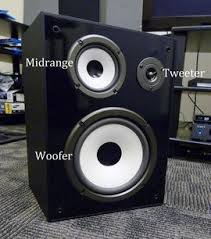
Tweeter speaker.
Tweeters typically cover the range of 2 kHz-20kHz, though some speciality tweeters can go as high as 100 kHz. Traditionally, tweeters were designed pretty much the same way as other speakers just smaller. The trouble is that sound at that frequency is pretty directional, meaning that the highs in your music sound best when the tweeters are pointed right at you. Modern tweeters are starting to adopt a dome version that uses a soft dome diaphragm made from polyester film, silk, or polyester fabric that has been impregnated with a polymer resin. (source for information:https://www.howtogeek.com/354985/what-are-woofers-mid-range-speakers-and-tweeters/)
(source for image:https://encrypted-tbn0.gstatic.com/images?q=tbn:ANd9GcTZu7KIB9gs2C8W7LY0TKFeiLLikIs4gXpJ8SPO5CR-cSB-tVX_Og)
Tweeter speaker.
Tweeters typically cover the range of 2 kHz-20kHz, though some speciality tweeters can go as high as 100 kHz. Traditionally, tweeters were designed pretty much the same way as other speakers just smaller. The trouble is that sound at that frequency is pretty directional, meaning that the highs in your music sound best when the tweeters are pointed right at you. Modern tweeters are starting to adopt a dome version that uses a soft dome diaphragm made from polyester film, silk, or polyester fabric that has been impregnated with a polymer resin. (source for information:https://www.howtogeek.com/354985/what-are-woofers-mid-range-speakers-and-tweeters/)
Microphones
https://www.bhphotovideo.com/images/images2500x2500/Shure_SM58S_SM58S_Cardioid_Dynamic_68464.jpg
Dynamic microphone
Microphone/ SM58 - This Is also know as a dynamic microphone and it's what singers use to speak through or sing through that is connect an XLR cable that connects to the mix. The mic sometimes will be attached to a mic holder that is connected to a mic stand. I've learnt, the case of a dynamic microphone, a very thin diaphragm of Mylar or other material is attached to a coil of hair-thin copper wire. The coil is suspended in a magnetic field and, when sound vibrates the diaphragm, the coil moves up and down, creating a very small electrical current. The electrical signal is attached to a connector on the microphone. Just plug it in and it works. Source for information: https://quizlet.com/247356975/audio-production-quiz-2-flash-cards/)Polar patterns
https://blog.discmakers.com/2015/03/pros-and-cons-of-the-figure-8-mic/
Polar pattern refers to a microphone's directionality or pickup pattern the three- space surrounding the capsule where it is most sensitive to sound."An omnidirectional polar pattern picks up sound in a 360-degree radius – it is equally sensitive to sound at all angles. Imagine its pattern as a perfect sphere in three directions. This makes omnidirectional microphones ideal for studio recordings where the objective is a natural, open sound. These microphones are especially well-suited for recording acoustic instruments and when recording a wide sound source, such as an orchestra or choir. They’re also good for lavalier mics, such as the LC82 MD of the MicroLite series, since the user can move his or her head without the volume varying. Of course, all this means that omnidirectional mics are not generally recommended for live performances, where they’re likely to pick up unwanted sounds such as amplified instruments or a PA system and thus cause feedback. They’re also not recommended when recording in an untreated room with poor acoustics. In those situations close miking is advised, and that’s where a cardioid mic comes in. We’ll explore the pros and cons of cardioid mics in our next polar pattern instalment. "http://www.akglife.com/polar-patterns--part-1-omnidirectional--technology
"Cardioid is the most widely used pattern in professional microphones. It provides reliable performance in both stage and studio settings—making it an excellent “jack of all trades” polar pattern. Cardioid mics have a heart-shaped pickup pattern and are most sensitive in the front of the mic. As you move around to the sides and bottom of the microphone, the cardioid pattern becomes less sensitive and will pick up less sound. A good way to visualize this is to think of the cardioid pattern as an apple, with the microphone as the stem. The closer you are to the ‘stem’, the less sensitive the mic is. "http://www.akglife.com/polar-patterns--part-2-cardioid--technology
"The figure of eight is similar to cardioid mics where it picks up sound in front, become less sensitive around the sides and completely reject sound at the rear. They use an even tighter pickup area at the head of the mic, quickly taper to reject sound from the sides and have a very small lobe of sensitivity near the rear of the mic. You could say it’s the stricter, more “focused” brother of the cardioid pattern. "http://www.akglife.com/polar-patterns--part-4-figure-8--technology
Condenser Microphone
https://www.neumann.com/homestudio/en/what-is-a-condenser-microphone
I've learnt that the condenser microphone is similar to a dynamic microphone as they are both used to enhance the sound through it more. It consists of a thin membrane in close to a solid metal plate that must be electrically conductive. When sound waves hit the diaphragm and the distance between the two plates changes. this results in the changes to the rhythm of the sound waves.The condenser capsule’s output voltage is actually quite high but it produces almost no current because so little energy is stored in this small capacitor. https://www.thoughtco.com/condenser-vs-dynamic-microphones-1817725
I've learnt large-diaphragm microphones (LDMs) are most often the choice for studio vocals and any instrument recording where a deeper sound is desired. A large-diaphragm microphone warms up the sound of what it's recording, which also leads to the myth that most LDMs reproduce low frequencies better than small diaphragm mics.https://www.thoughtco.com/condenser-vs-dynamic-microphones-1817725
I've learnt that small-diaphragm microphones (SDMs) are the best choice when you want a solid, wide-frequency response and the best transient response, which as noted above, is the ability for your microphone to reproduce fast sounds, such as stringed instruments. SDMs are also the preferred choice for concert taping. The microphone delivers incredible sound quality for lead vocals and solo instruments and has nine selectable polar patterns, plus three attenuation levels for close-up recording or high-output sources. And three switchable bass-cut filters help to reduce wind noise and stage vibration.https://www.thoughtco.com/condenser-vs-dynamic-microphones-1817725
Mixing desk
(source for image: https://eventprojection.co.uk/wp-content/uploads/2016/11/yamaha_mg24_14fx-300x204.jpeg)


The mixing desk also is known as a mixing console, soundboard or mixer is capable of performing a range of capabilities and applications. All the channels serve the same purpose, providing a sound system for each microphone, speaker system and panellists. It's required for the microphones to be amplified over the speaker system. There are two types of mixers one is an analogy and the other digital. Analogue is heavier than the digital put the digital has a better sound than analogue.
The input section https://www.dawsons.co.uk/blog/wp-content/uploads/2013/03/inputs1.jpg
A mixer will have a number of input channels with its own audio signal combined with other signals from other channels. This is normally based at the back of the mixer or at the front on top with two types of inputs/ inserts a three pin XLR socket which is commonly connected to microphones and the 1/4 jack that's connected to guitars, pianos or devices such as CD players, iPods or laptops. There will at least be some 1/4 jacks or phono sockets at the master section for connecting stereo signals.
The output section
The mixer combines all signals from all channels then goes out the mixer through the output section. All mixers have a main out a 1/4 jack inserts for left and right and a headphone or phones output. There will be a knob or fader controlling the overall of the mix (master fader) and there will be a knob or fader controlling the phones output independently. Also, there will be a mono 1/4 that for the aux if when playing music out loud or wanting to connect a device to the mixer. Smaller mixers have a tape in or tape out a duo of phono sockets.
Channel Strips
A channel is a basic unit for the mixer. It's also the reason why many channels are independent by the mix, the channel controls are repeated over the mixer surface so it may look confusing but it's not that confusing. (image source: https://www.dawsons.co.uk/blog/wp-content/uploads/2013/03/Gain.jpg)
Gain - This controls the input levels of each individual channel. The microphones produce a weak amplitude so that's why turning up the amplitude, increases the amount of amplifier applied to the mic. This is important because when it comes to performance there are different types of singers with different voices and turning up the gain will able you to hear the singers with not so much power in their voice.
(image source:https://www.dawsons.co.uk/blog/wp-content/uploads/2013/03/EQ.jpg)
Equalizers(EQ) - EQ controls the tonal of the sound allowing the user to change the curve in the sound. There's a knob that controls the levels of the bass labelled as low, the other one controls the levels of frequency labelled as medium and another one controls the treble labelled as high.
(image source: https://www.dawsons.co.uk/blog/wp-content/uploads/2013/03/auxilliary.jpg)
Amplifier(AUX) - The AUX knob controls the levels of Auxilliary, sent off to the AUX output. This allows the user to create mixes to adjust the levels of the channel signal. The purpose of this is to send signals to the monitors on the stage to help them hear what they are playing clearly. This also sends the audio into an effective unit where you can use reverb or delay allowing engineers to adjust the levels of effect for each individual channel.(image source:https://www.dawsons.co.uk/blog/wp-content/uploads/2013/03/Pan.jpg)
Pan - Panorama is the knob that controls which area of the field the signal is put out to when turning it either to left, right or centre for the speakers. This is useful because it reduces the amount of sound coming out from a speaker prevent the speaker from popping and the person sitting in front won't getting strain in their eardrums. (image source:https://www.dawsons.co.uk/blog/wp-content/uploads/2013/03/mute.jpg)
Mute - The mute button allows engineers to individually mute a channel which stops the sound from coming out of the output. The pro for this is your ability to mute if someones going off or if you're trying to change the caballing and you don'twant there to be bad feedback, so muting the mic will prevent this from happening.
Channel faders - This controls the levels of sound sent to the output.
There are four buttons that you would use when performing. The first one allows the engineer to individually listen to the channel whilst in headphone or earphones. The second and third one allows you to branch together onto subgroups to come out on the monitors.
The last one is the button that sends signals to the master section and allows there to be sound.
Master fader and master outputs - This the main output that controls the overall sound in the speakers and controls the overall settings for the channel strips. This is very useful because when the volume on the channels is high, the master fader will prevent the sound from reaching the red zone.
ODB - How to measure the levels and that's the required sound level
DB - This means decibels
There are two types of mixers analogue and digital mixers. People have preferred either one and both mixers have their own advantages and disadvantages. They both do the same things but they have different prices.
Analogue mixer
(source for image: https://hirefrequencies.co.uk/product/allen-heath-zed22-fx/)
 The analogue mixer is useful as your ability to manually change everything with your hands. The mixer is able to have 5-32 channels and work perfectly well and it can produce clear sound even when there are more than 20 inputs in the mixer. The mixer is more suitable to when it comes to environmental factors such as a dusty fader, dirty knobs and bad power that adds noise into the sound.
There are two types of mixers analogue and digital mixers. People have preferred either one and both mixers have their own advantages and disadvantages. They both do the same things but they have different prices.
Analogue mixer
(source for image: https://hirefrequencies.co.uk/product/allen-heath-zed22-fx/)
The analogue mixer is useful as your ability to manually change everything with your hands. The mixer is able to have 5-32 channels and work perfectly well and it can produce clear sound even when there are more than 20 inputs in the mixer. The mixer is more suitable to when it comes to environmental factors such as a dusty fader, dirty knobs and bad power that adds noise into the sound.
Digital mixer
(source for image:https://www.sweetwater.com/sweetcare/media/2016/02/Sends-on-Faders.jpg)
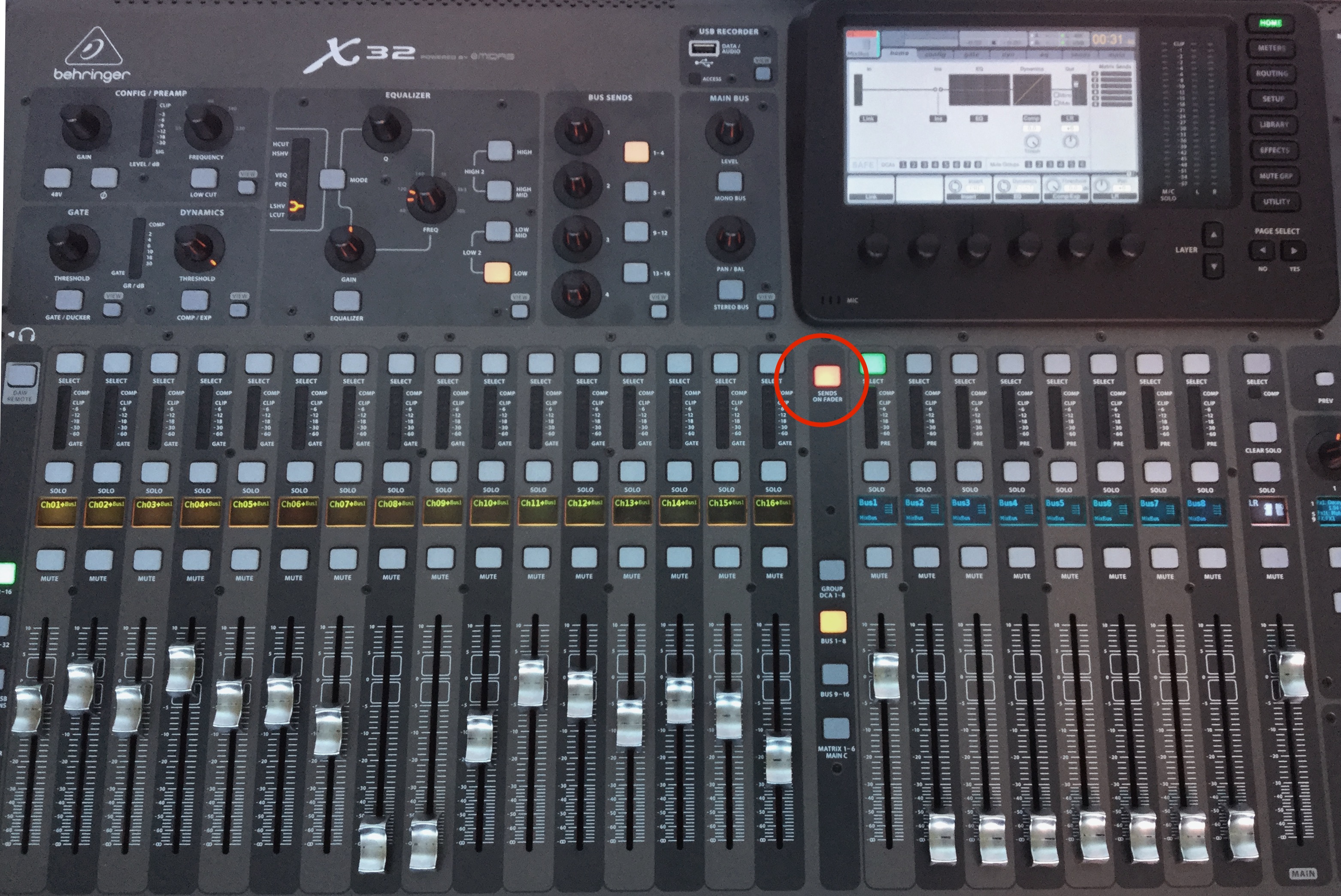 The digital mixer comes very handily when it comes to adjusting the channel because you're able to connect the mixer to an iPad by Bluetooth. This allows you to see what channels you have brunched up and also you can easily change the settings of the specific channel. This allows you
https://www.sweetwater.com/insync/analog-vs-digital-live-sound-mixers/
(source for image:https://www.sweetwater.com/sweetcare/media/2016/02/Sends-on-Faders.jpg)
The digital mixer comes very handily when it comes to adjusting the channel because you're able to connect the mixer to an iPad by Bluetooth. This allows you to see what channels you have brunched up and also you can easily change the settings of the specific channel. This allows you
to change the settings within the mix on the touchscreen.
https://www.sweetwater.com/insync/analog-vs-digital-live-sound-mixers/
| Analog Mixer | Digital Mixer |
|---|---|
| Connecting Inputs | |
| Inputs are connected to the back of the board and correspond directly with channels. | Inputs on the back of the board may correspond with faders but may need to be assigned. Additional inputs via Ethernet stage boxes may also need to be assigned to faders. |
| Adjusting Channel Settings | |
| Dedicated controls on each channel strip allow you to quickly dial in mic gain, EQ, and other settings while providing a summary of channel settings at a glance. | Select buttons on each channel allow you to use a single master section to dial in gain, EQ, dynamics, and additional settings. |
| Setting Up Sends | |
| Individual send knobs on each channel let you quickly dial in additional mixes. Sends typically have master volumes and pre-/post-fader assignment buttons. | Sends may be set up from the master section by setting the channel layout to send mode or by another method. Outputs are often freely assignable in the master control section, allowing you to pair physical outputs with send or group buses. |
| Setting Up Groups | |
| VCA groups are usually assigned via small buttons along the fader or elsewhere on the channel. The number of groups is always limited by the circuitry. | While some digital mixers handle groups similar to the way analogue mixers do, group assignments are typically much more fluid and far less limited. With layered banks of faders, groups may live on their own layer for easy access during live mixing. |
| Accessing Effects and Processing | |
| Typically, analogue mixing consoles don’t have effects or master bus processing onboard. When they do have effects, they’re usually assigned to one of the auxiliary send buses. Other channel and bus processing is usually available via insert points. | Most digital mixers include extensive effects and processing, minimizing the need for a rack full of outboard gear and effects processors. The tradeoff is that if you want to use outboard gear, you’ll probably need to route the signal through an assignable send. |
This is a video of me connecting an analogue mixer to a passive speaker
(source for information: https://youtu.be/7VXwZytqG9Q)
This video is a video of me connecting step by step the mixer to the passive speaker and here I'm demonstrating and telling you what parts I'm using and where it's being connected to. This shows my understanding of what I have been learning in the lessons and how effective it is when you're actually listening in the lesson so you have a clear understanding of what you're doing and you're doing things for your benefit and understanding.


Comments
Post a Comment